

Most of us live business inside a tab graveyard. A video call client open in one window. A messaging app in another. A social network for posts and updates. A marketplace tab for buying. A separate dashboard for selling. A different inbox for clients, another for suppliers, and a notification feed that fragments your attention across six logos every hour of the working day.
OBS was built to end that. Not by adding another tab to the stack, but by replacing it. On OBS, the call you take, the message you send, the post you publish, the product you list, and the deal you close all happen in the same place — to and from the same people, who are real members of the same global community.
Here is what that looks like in practice.
Video calls — face to face, anywhere in the world
Open a chat with anyone on OBS and you are one tap from a video call. One-to-one, small group, or full team room — high-quality audio and video, screen sharing for when you need to walk someone through a document or a deck, and a clean interface that gets out of the way of the conversation. There is no separate app to install, no meeting link to email, no plug-in to update. The person you have been messaging is already in the room when you press call.
The same infrastructure powers the conversations sellers have with buyers about a product, the diligence calls investors have with founders, the consultations service providers run with new clients, and the team calls that happen inside every member's working day. Because the call lives next to the chat, the file you sent yesterday, and the order you placed last week, the context is always there. The call ends and the conversation just continues — in writing, in a follow-up, in a transaction.
Messaging — built for business, not just chat
OBS messaging is fast, encrypted, and global. Send a text, a voice note, a photo, a video, a document, a contract, a quote. Reply in threads. React with a tap. Mention a teammate to pull them in. Forward a listing to a buyer or a supplier without leaving the conversation.
What makes it different from a generic chat app is that everyone you talk to is a real member of the OBS community, with a verified profile, a public store if they have one, and a track record you can see. The supplier you message has a portfolio attached to their account. The buyer who pings you about a product has a history on the platform. The investor who reaches out has a profile you can read before you reply. The conversation does not start cold — it starts with context.
Group chats turn into project rooms. Direct messages turn into deals. And because the same inbox handles your community conversations and your commerce conversations, nothing important gets buried in a separate app you forgot to check.
Social posting — share your work, build your audience
Every member of OBS has a feed. Post text, photos, video, links to your listings, milestones from your business, opinions on your market — whatever you would publish on a social platform, you publish here, to an audience that is actually relevant to what you do.
Followers see your posts. Communities surface them to members with shared interests. Engagement turns into reach, and reach turns into something you can actually measure: profile visits, store visits, message requests, offers on listings, hires for your services. The post you wrote on Sunday night becomes the inbound enquiry on Monday morning, because the people seeing it are not strangers scrolling for entertainment — they are members of a network built around doing business.
This is social media with a return on attention. The content does not vanish into an algorithm optimised for time-on-platform. It compounds into a profile, a following, and a pipeline.
Online markets — list, sell, ship, get paid
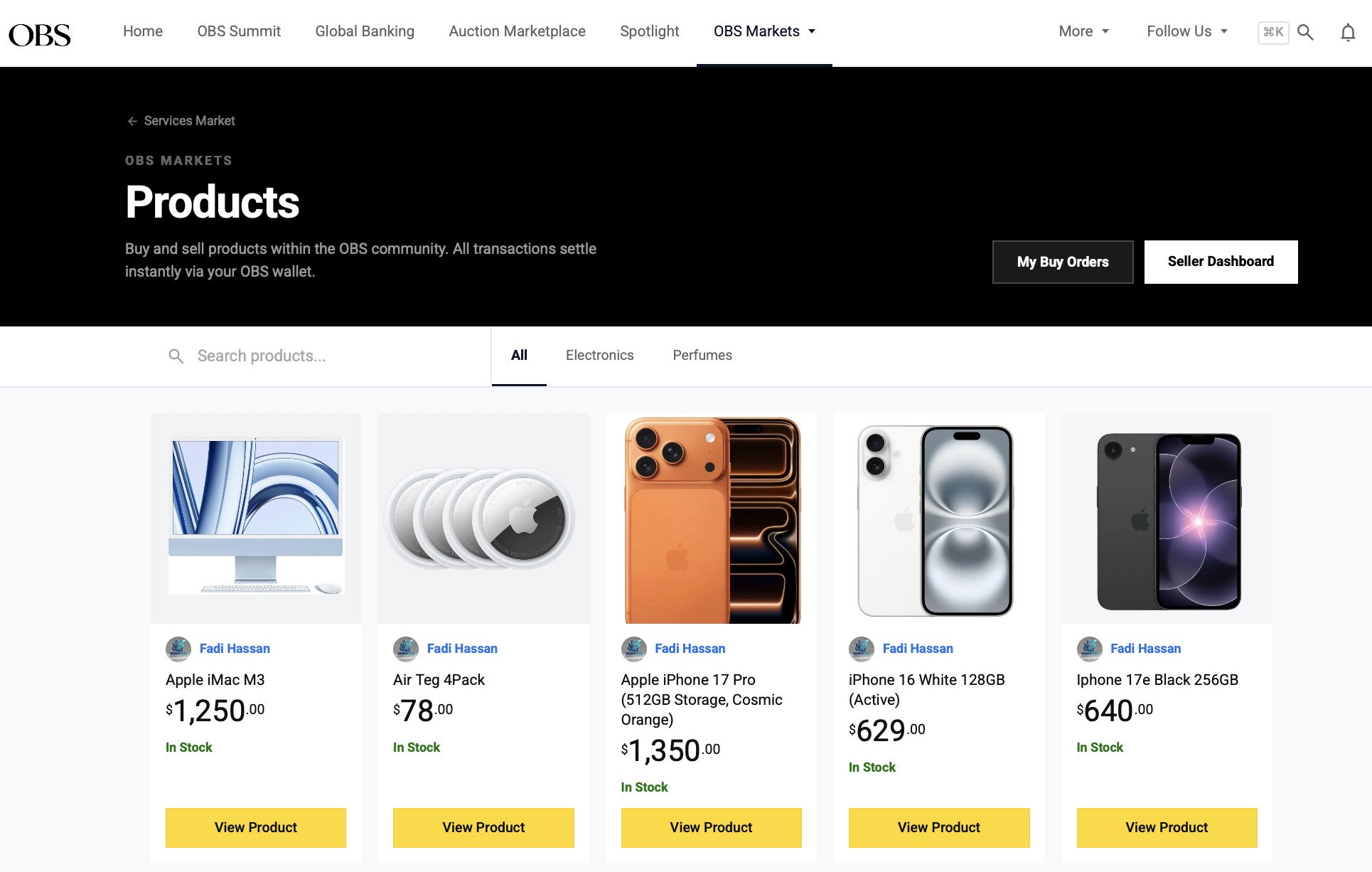
OBS Markets is the commercial side of the same network. Open a shop in minutes, list physical products, professional services, or both, and start selling to a global audience that is already on the platform. Every seller gets a public storefront under their own username — a clean, branded page that holds your full catalogue in one place.
Buyers discover you through search, categories, recommendations, the feed, your posts, your followers, and the communities you participate in. The same network that fuels the conversations also fuels the transactions. List once. Reach the world. Get paid through the platform you and your buyer both already trust.
Sellers can run live auctions. They can launch promoted listings inside the built-in advertising system, with $100 in ad credit available to every new account to test what works. And they can manage orders, messages, calls, and follow-ups from the same dashboard — because every part of the sale already lives in the same app.
Communities — the rooms where business gets done
Beyond the feed and the marketplace, OBS organises itself into communities: groups of members built around an industry, a region, a sector, a shared interest. Join the ones that fit what you do. Post inside them, message other members, discover listings that come from inside the group, and host or attend video calls scheduled by the community itself.
Communities are where the platform's network effect turns into something tangible. A seller listing inside a relevant community gets surfaced to qualified buyers. A founder posting an update gets feedback from operators who actually know the space. A service provider joining a community in their vertical becomes visible to the exact buyers they spent years trying to reach.
One identity, one inbox, one platform
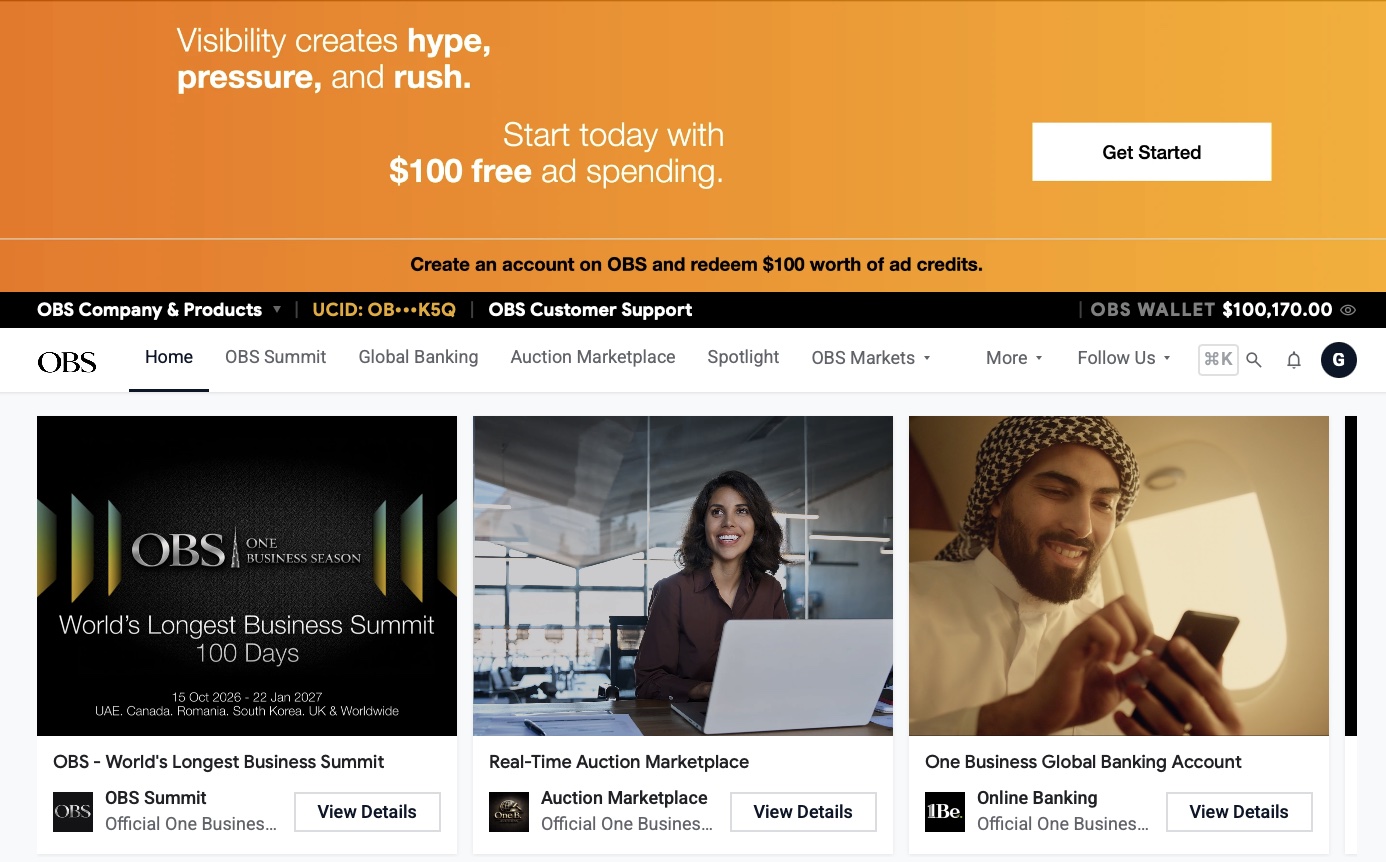
The decisive thing about OBS is not any single feature — it is what happens when all of them sit on top of the same identity, the same network, and the same data. Your profile is your professional identity, your storefront, and your social account at once. Your inbox holds the call you took yesterday, the order that just shipped, the offer a buyer made overnight, and the message from a teammate about tomorrow's deadline.
There is no switching between apps to find context, no copying a link from one place to another, no exporting contacts to import them somewhere else. The platform you wake up to in the morning is the same one you close at the end of the day, and everything you did across it accrues to the same account.
Built global, made personal
OBS members come from the Gulf, Europe, Asia, Africa, and the Americas. They speak different languages, run different businesses, and operate in different time zones — but they meet on the same platform. The video call that bridges Dubai and São Paulo, the message that closes a deal between Riyadh and Singapore, the listing that ships from Istanbul to London — all of it happens inside one app, between members of one community.
Global by infrastructure. Personal by design. Every connection is between real, identifiable members with real profiles, real reputations, and real reasons to make the relationship work.
Why this matters
The cost of running a modern business is not just rent and headcount. It is the friction of moving information between five tools, the audience you have to rebuild every time you start somewhere new, the platform fees on every transaction, and the time you lose to context-switching between apps that were never designed to work together.
OBS replaces that stack. The conversations, the relationships, the content, the commerce, and the community all live in the same environment, accruing to the same account, compounding into the same network. You spend less time managing tools and more time doing the work the tools were supposed to be supporting.
Video calls. Messaging. Social posts. Communities. A global marketplace. Storefronts, services, auctions, advertising, and analytics — under one identity, in one app, on one platform that the world is already using to do business.
This is OBS. One place. Everyone you need to reach. Every way you need to reach them.